How Saudi Businesses Are Using monday.com to Hit Their Vision 2030 Digital Goals
When Saudi Arabia launched Vision 2030 in 2016, it set out an ambitious roadmap: reduce the country’s dependence on oil, build a knowledge-based economy, and digitalize operations across both the public and private sectors. Nearly a decade later, the results are visible. The private sector’s contribution to GDP has climbed to 47%, the government has digitized 98% of all public services, and the Saudi SaaS market – valued at $2.86 billion in 2024 – is projected to reach $6.49 billion by 2030.
But Vision 2030 is not just a government story. It is a business story. Every Saudi company operating in construction, real estate, logistics, healthcare, or professional services is feeling the same pressure: modernize operations, improve efficiency, reduce reliance on manual processes, and demonstrate the kind of organizational agility that the new Saudi economy demands.
For a growing number of Saudi businesses, monday.com has become the platform at the center of that transformation. And Meta Lean, as a Platinum monday.com Partner in the GCC, is the team helping them get there.
What Vision 2030 Actually Demands from Saudi Businesses
Vision 2030 is built on three pillars: a vibrant society, a thriving economy, and an ambitious nation. For businesses, the practical translation of those pillars comes down to four operational imperatives that are reshaping how Saudi companies work.
Operational efficiency at scale
Saudi Arabia’s National Transformation Program has set clear targets for productivity improvements across both public and private sectors. Businesses that still rely on manual workflows, siloed data, and disconnected tools are finding it harder to meet those benchmarks. The expectation – from government partners, from investors, and from international clients – is that Saudi organizations operate with the same level of digital sophistication as their global counterparts.
Data-driven decision making
Vision 2030 places significant emphasis on data and AI as drivers of economic growth. The National Strategy for Data and AI has a specific goal: position Saudi Arabia among the top three countries globally in digital government maturity by 2030. For private sector companies, this creates a clear signal – organizations that can demonstrate real-time reporting, performance dashboards, and data-backed decisions are better positioned for government contracts, partnerships, and investment.
Cross-sector collaboration
The scale of Vision 2030’s giga-projects – NEOM, the Red Sea Project, Diriyah, and others – requires an unprecedented level of coordination between developers, contractors, government agencies, and international partners. Companies that cannot manage complex multi-party workflows digitally are being left out of the ecosystem entirely.
Speed to execution
Vision 2030 is now in its final phase, running from 2026 to 2030. The window for preparation is closing. Saudi businesses that have not yet built the operational infrastructure to execute at scale are under real time pressure to catch up. This is not a future challenge – it is a present one.
Why monday.com Fits the Vision 2030 Business Context
monday.com is not a niche tool for a specific industry. It is a work operating system – a platform that can be configured to manage projects, sales pipelines, HR workflows, procurement processes, service operations, and executive reporting all in one place.
For Saudi businesses trying to consolidate scattered operations onto a single digital platform, this flexibility is exactly what is needed. The platform does not require a long IT implementation cycle. It does not need expensive customization. And it does not require a dedicated developer to maintain. Teams can be up and running within weeks, with workflows that reflect exactly how they operate.
The Cloud First Policy introduced under Vision 2030 specifically encourages Saudi public and private sector entities to prioritize cloud-based solutions. monday.com, as a SaaS platform with enterprise-grade security and compliance capabilities, fits directly within that mandate.
How Saudi Businesses Are Using monday.com Across Key Sectors
Construction and Project Management
Saudi Arabia’s construction sector is one of the most active in the world, driven by giga-projects and a sustained pipeline of commercial and residential development. Construction companies using monday.com are managing project timelines, subcontractor coordination, material procurement, site progress tracking, and client reporting all in one platform.
For contractors working on large-scale government projects, the ability to provide real-time progress dashboards to clients and stakeholders is increasingly a requirement rather than a nice-to-have. monday.com makes this straightforward without requiring custom software development.
Real Estate Development and Sales
Saudi Arabia’s real estate sector is expanding rapidly, driven by Vision 2030’s urban development agenda and increasing demand from a young, growing population. Real estate developers are using monday.com to manage project launches, broker networks, investor pipelines, and handover coordination – replacing fragmented WhatsApp and Excel workflows with a single, automated platform.
For developers managing multiple projects simultaneously across Riyadh, Jeddah, and emerging markets like NEOM’s surrounding areas, the ability to track the status of every project, every unit, and every stakeholder relationship from one dashboard is a significant operational advantage.
Government Contracting and Professional Services
Saudi companies that work with government entities – consultancies, IT firms, engineering companies, professional service providers – face increasing pressure to demonstrate structured project management and transparent reporting. monday.com gives these teams the ability to build audit-ready workflows, track deliverables against contract milestones, and produce standardized reports for government clients.
With the Saudi government now operating some of the most digitally sophisticated procurement processes in the region, suppliers that cannot demonstrate equivalent operational maturity are at a competitive disadvantage.
Logistics and Supply Chain
Saudi Arabia’s logistics sector is a key pillar of Vision 2030’s economic diversification goals, with significant investment in infrastructure and connectivity. Logistics companies using monday.com are managing shipment tracking, supplier coordination, customs documentation workflows, and performance reporting – reducing the manual overhead that slows down operations and increases errors.
What Changes When Saudi Teams Move to monday.com
The operational shift that Saudi businesses report after implementing monday.com follows a consistent pattern. Before implementation, information is scattered across email threads, WhatsApp groups, and spreadsheets. Leadership visibility is limited. Status updates require manual effort. Reporting takes hours every week.
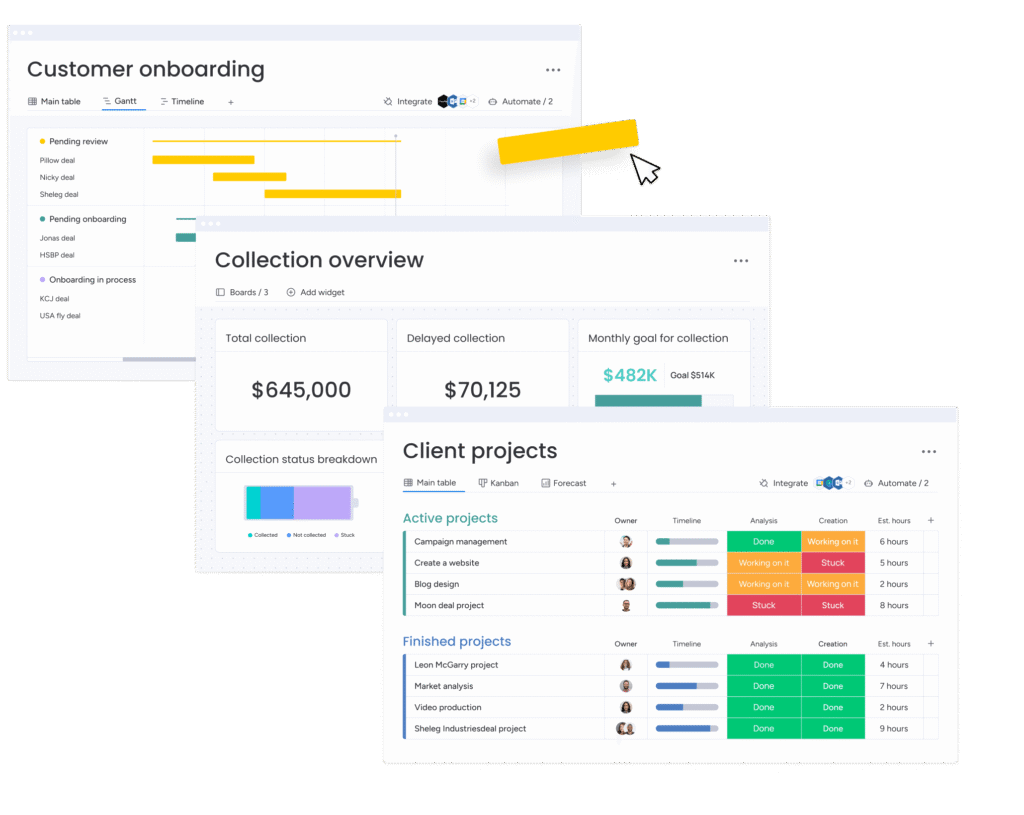
After implementation, work becomes visible. Every project, every task, every deadline, and every team member’s workload is in one place. Automated workflows handle the routine updates and notifications that previously consumed administrative time. Leadership dashboards give executives a real-time view of organizational performance without anyone needing to compile a report.
For Saudi businesses operating in a market that is moving fast, this shift from reactive to proactive management is not just an efficiency improvement. It is a strategic necessity.
Why the Implementation Partner Matters as Much as the Platform
The monday.com platform itself is only part of the equation. The way it is configured – the board structures, automation rules, permission settings, dashboard layouts, and integration connections – determines whether it delivers value or becomes another tool that teams work around.
Meta Lean brings deep experience implementing monday.com for businesses across the GCC, including Saudi Arabia. As a Platinum Partner, Meta Lean designs workflows that reflect how Saudi organizations actually operate – accounting for local business practices, multi-stakeholder environments, Arabic language requirements, and the specific reporting formats that Saudi clients and government partners expect.
The implementation process includes workflow design, configuration, data migration from existing systems, team training delivered in Arabic or English, and ongoing support. For Saudi businesses working toward Vision 2030 goals, this means a partner who understands both the platform and the market context it is being deployed in.
Ready to Align Your Operations with Vision 2030?
Meta Lean helps Saudi businesses across construction, real estate, professional services, and government contracting implement monday.com environments that are built for how they actually work – and for the performance standards that Vision 2030 demands.
If your organization is ready to move beyond spreadsheets and disconnected tools and build the operational infrastructure that the next phase of Vision 2030 requires, get in touch with Meta Lean for a free consultation.
Yes. monday.com supports Arabic language across its interface, making it accessible for Saudi teams. Meta Lean provides training and onboarding support in Arabic for teams that prefer to work in their native language.
monday.com's dashboard and reporting capabilities allow Saudi businesses to produce structured, real-time reports aligned with the performance tracking requirements of government contracts and Vision 2030 program deliverables. Custom dashboards can be configured to track KPIs relevant to specific programs or ministries.
Yes. monday.com's portfolio management capabilities allow organizations to track multiple large-scale projects simultaneously, with dashboards that aggregate data across projects and give leadership a consolidated view of progress, risks, and resource allocation. Several contractors and developers working on Vision 2030 projects use monday.com for exactly this purpose.
A standard implementation for a Saudi business - covering core operational workflows, dashboards, and team training - typically takes three to four weeks with Meta Lean's team. More complex implementations involving multiple departments or integrations with existing systems may take six to eight weeks.
Construction, real estate, professional services, logistics, and government contracting are among the most active sectors in Saudi Arabia adopting monday.com. These sectors share a common challenge: managing complex, multi-party workflows at scale - exactly the problem monday.com is designed to solve.